
AI & Automation · 7 min
RAG for businesses: what Retrieval-Augmented Generation is and what it is for
RAG (Retrieval-Augmented Generation) is a technique that connects a language model to a company's documents and data: first it retrieves the relevant information from the knowledge base, then it uses it to generate an answer. It is the most reliable way to make AI answer with the company's real information, reducing errors and made-up answers.
Key points
- RAG connects AI to company documents before generating the answer.
- It reduces errors and made-up answers by providing real, up-to-date information.
- It enables traceability of sources and control over the data.
- It is the foundation of reliable internal assistants and customer support.
Why a model on its own is not enough
A «pure» language model answers based on what it learned during training: it does not know a company's internal documents, updated price lists or specific procedures, and it may produce answers that are plausible but wrong. RAG solves this limitation by providing the model, at the moment of the question, with the right information retrieved from company sources.
How it works, in practice
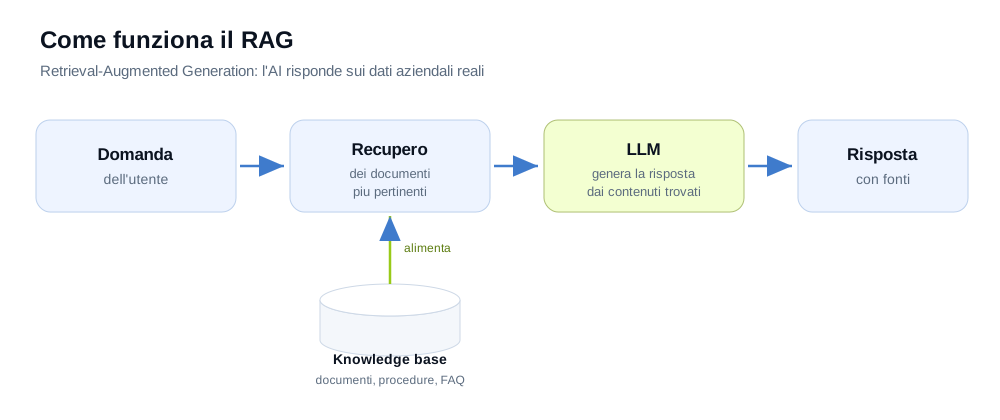
The RAG flow has two phases. In the first, the system searches the company documents for the passages most relevant to the question. In the second, it passes these passages to the model, which generates an answer based on them, often citing the sources.
- Retrieval: searching for the relevant content in the knowledge base.
- Augmentation: the content found is added to the context.
- Generation: the model answers based on that content.
Benefits for the company
RAG brings three concrete benefits: up-to-date answers (you just update the documents, no need to retrain the model), traceability (you can show the source of every answer) and confidentiality (the data stays in the company systems). It is the technical foundation of reliable internal assistants, customer support and document search.
FAQ
What is the difference between RAG and training a model? +
Training modifies the model with new data and is expensive; RAG leaves the model unchanged and provides it with the information at the moment of the question. For most companies RAG is simpler, cheaper and easier to keep up to date.
Does RAG eliminate AI errors entirely? +
It greatly reduces them because it anchors answers to real documents, but it does not eliminate them: the quality depends on how good and well organised the retrieved content is.
What is needed to implement RAG? +
A well-ordered knowledge base (documents, procedures, FAQs) and a system that indexes it and connects it to the model. The quality of the knowledge base is the decisive factor.
Want to apply these ideas to your company?
Tell us your goals and context: we reply with a concrete initial framing on AI, software, automation and digital marketing.
Request an assessment