
AI & Automation · 7 min
AI agents for businesses: what they are and how to really use them
An AI agent is a system based on language models that can not only respond, but also perform actions: consult data, use tools, complete steps of a workflow toward a goal. Unlike a chatbot, which converses, an agent acts — within defined rules and controls. For businesses, this opens up the automation of processes that previously required constant human intervention.
Key points
- An AI agent acts, it does not just converse: it uses tools to complete tasks.
- It shines on structured workflows that still have variants (tickets, leads, documents).
- You need permissions, human approvals and logs for critical actions.
- It is a supervised digital colleague, not a system without control.
Agent, chatbot and automation: the differences
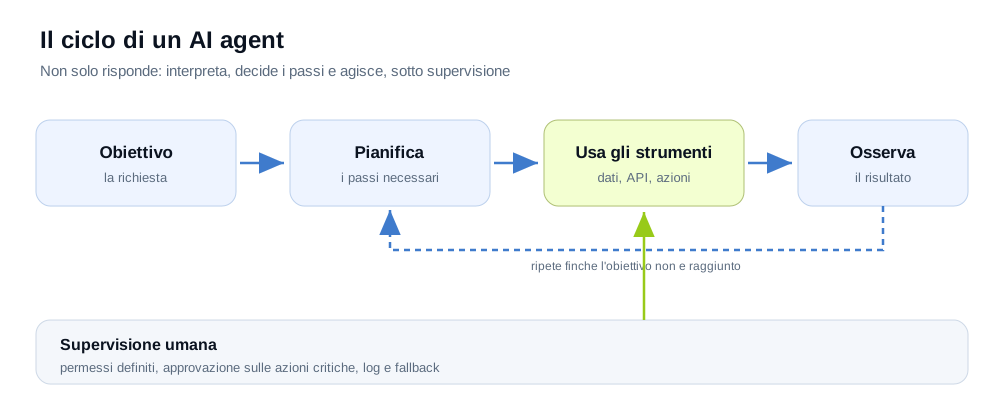
A chatbot answers questions. Traditional automation follows fixed rules. An AI agent combines the two worlds: it interprets a request, decides the necessary steps, uses tools (search, databases, APIs, sending email) and completes a task, adapting to the context.
- Chatbot: converses and informs, does not act.
- Classic automation: executes rigid rules, does not adapt.
- AI agent: interprets, decides the steps and uses tools to act.
Where AI agents create value
The strongest business use cases are structured workflows that still have variants: handling tickets and internal requests, lead qualification and enrichment, processing documents and cases, researching and summarising information, and operational support for teams. In all these cases the agent reduces manual work while maintaining traceability.
Human oversight, limits and governance
The effectiveness of an AI agent depends on the boundaries within which it operates. You need clear permissions (what it can and cannot do), human approval points for critical actions, decision logs and fallback mechanisms. A well-designed agent is not «autonomous without control», but a digital colleague with defined rules, supervision and accountability.
This is particularly important in European contexts, where traceability and human oversight are also compliance requirements.
FAQ
What is the difference between an AI agent and a chatbot? +
A chatbot answers and informs; an AI agent performs concrete actions, using tools and data to complete a task within defined rules.
Are AI agents safe to use in a company? +
Yes, if designed with limited permissions, human approval points, logging and fallback. Safety depends on the boundaries and governance, not on the model itself.
Which process should you start with? +
With a repetitive, well-documented workflow that has accessible data — for example handling internal requests or qualifying leads — to measure the value before expanding.
Want to apply these ideas to your company?
Tell us your goals and context: we reply with a concrete initial framing on AI, software, automation and digital marketing.
Request an assessment