
AI Strategy · 6 min
High-ROI AI use cases: how to choose them in your company
A high-ROI AI use case is an application of artificial intelligence to a process that is frequent, costly or error-prone, where the impact on time, costs or revenue is measurable. Choosing them well is the decision that determines the success of an AI initiative: a few well-targeted applications are worth more than dozens of experiments disconnected from the business.
Key points
- Good use cases are frequent, data-rich and have a verifiable output.
- The impact/effort matrix helps you start from the «quick wins».
- Every initiative starts from a baseline and a measurable target.
- A pilot on a narrow perimeter always precedes scaling.
The criteria for recognising a good use case
Not every process is suited to AI. The best candidates share a few characteristics: high frequency, repeatable rules, data that is already available and a verifiable result. The more repetitive and data-rich an activity is, the more predictably AI can cut time and errors.
- High frequency: the process repeats many times a day or a week.
- Available data: structured information or documents already exist to work on.
- Verifiable output: the result can be checked and measured.
- Clear impact: it affects an identifiable cost, time or revenue.
The impact / effort matrix
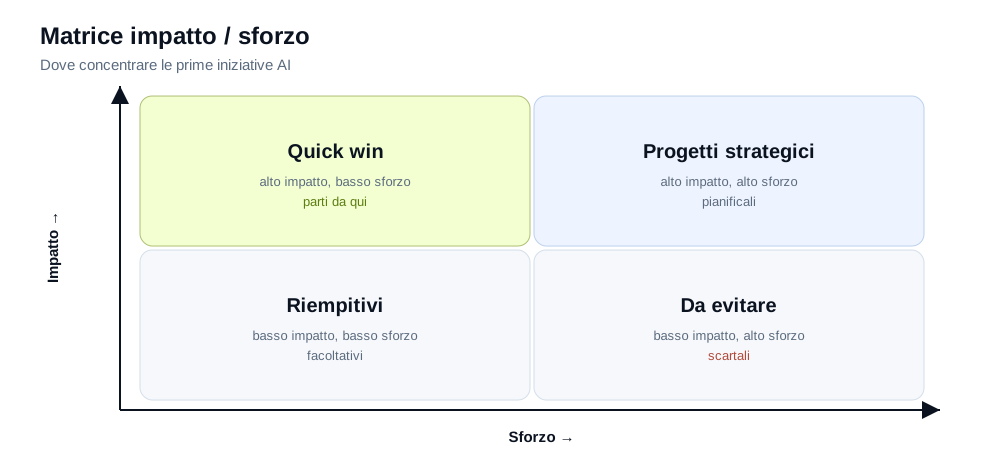
A simple tool for prioritising is the impact/effort matrix: use cases are placed along two axes — how much value they generate and how complex they are to deliver. You start from the quadrants with high impact and low effort (the «quick wins»), plan those with high impact and high effort, and discard the low-impact ones.
This approach avoids two common traps: chasing fascinating but barely useful projects, and spreading energy across many small initiatives with no visible effect on the business.
Validate with a pilot before scaling
Even the most promising use case needs to be validated. Before a company-wide rollout you define a baseline (current times, costs, errors) and a target, then run a pilot on a narrow perimeter. The pilot's numbers tell you whether to scale, adjust or stop — reducing the financial risk and building internal trust.
FAQ
How many use cases is it worth tackling at the start? +
Few and well-targeted. It is better to take one or two high-impact use cases through to a result than to run many parallel experiments with no measurable effect.
How do I tell whether a process has enough data for AI? +
If the activity already relies on documents, records or accessible structured information, the data is there. If instead the information lives only in people's heads, it must first be made explicit.
What is the most common mistake when choosing use cases? +
Starting from the technology («let's use an LLM») rather than from the business problem. AI should be chosen to solve a specific process with measurable impact.
Want to apply these ideas to your company?
Tell us your goals and context: we reply with a concrete initial framing on AI, software, automation and digital marketing.
Request an assessment